
.jpg?width=1200&height=600&name=ces_dog_frame_1200x600%20(1).jpg)
Part 3 — The AI Bottleneck Nobody Is Talking About
I’ve attended CES for four years in a row, and each year the AI messaging has grown louder. But this year felt fundamentally different.
At CES 2026, I genuinely don’t think I passed a single booth where AI wasn’t part of the conversation in one way or another. From consumer gadgets to industrial systems, from robotics to wearables to manufacturing platforms — everything was framed through the lens of artificial intelligence and machine learning.
The volume alone tells you something important: AI is no longer a side initiative. It has become the dominant mindset shaping how companies think about product development, differentiation, and long-term competitiveness.
When You’ve Seen a Few Technology Waves
In my career in technology, I’ve had the opportunity to witness several major platform shifts firsthand — the transition from mainframes to personal computing, the rise of the internet, the emergence of ubiquitous connectivity and cloud-scale storage, and the steady digitization of nearly every industry.
Each wave followed a familiar pattern:
-
Early skepticism
-
Explosive hype
-
Overpromising and experimentation
-
Real infrastructure investment
-
Long-term structural change
Looking at what’s happening with AI today, it’s clear we are already well into the structural change phase. Like it or not, AI is reshaping how products are designed, how systems operate, and how decisions get made — and it’s happening faster than most organizations can comfortably absorb.
This isn’t a future prediction anymore. It’s unfolding in real time.
Hype Is Easy. Operational AI Is Hard.
What CES made especially clear is the growing gap between AI demos and AI at scale.
It’s relatively easy to demonstrate a compelling model in a controlled environment. It’s much harder to:
-
Validate behavior across edge cases
-
Maintain data quality and traceability
-
Integrate models into production workflows
-
Govern safety, security, and compliance
-
Continuously retrain and improve systems
-
Operate reliably at an industrial scale
This is where many organizations will struggle. The bottleneck isn’t model innovation — it’s operational maturity.
Digital Threads Show What “Real” Looks Like
One of the most grounded examples of operational maturity I saw at CES came from Siemens, where they demonstrated how digital threads are applied across real manufacturing workflows — connecting design, simulation, additive manufacturing, and production optimization into a continuous data-driven lifecycle.
In the demo, a part flowed through CAD design, automated toolpath generation, simulation-validated build strategies before production, and process optimization, improving quality and yield. Each stage generated engineering data — geometry, parameters, performance metrics, and operational feedback — all connected through a unified digital thread.
Siemens demo showing digital thread workflow from design through additive manufacturing and optimization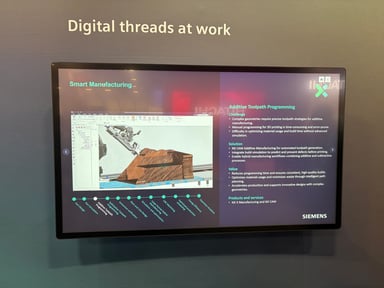
What makes this compelling isn’t the visualization — it’s the discipline. These systems reduce programming time, prevent defects before they happen, and accelerate production readiness by treating engineering data as a first-class asset across the lifecycle.
This is what operational AI actually looks like in practice: not flashy demos, but reliable, traceable, scalable systems that integrate deeply into real workflows.
Data Is the Real Differentiator
Whether we’re talking about robots navigating physical environments, smart glasses delivering ambient intelligence, or AI optimizing manufacturing processes, one truth cuts across all of it: the quality, consistency, and accessibility of engineering data determines success.
Robotics, AI, and machine learning will increasingly dominate how engineers design products, validate systems, and operate complex environments. But these technologies only perform as well as the data pipelines behind them.
Organizations that invest in:
-
Data consistency and normalization
-
Traceability across the lifecycle
-
Scalable analytics pipelines
-
Validation and governance frameworks
-
Closed-loop learning systems
…will move faster, reduce risk, and outperform those who treat data as an afterthought.
The Line Really Has Disappeared
CES 2026 didn’t just showcase impressive technology. It highlighted how quickly the boundary between science fiction and engineering reality is collapsing.
Robots are becoming physically capable and operational.
Wearables are becoming invisible interfaces.
AI is becoming embedded in every product and workflow.
The next decade will be defined not by who builds the flashiest models or hardware — but by who builds the strongest data foundations and operational discipline to scale them safely and reliably.
That’s where the real competitive advantage will live.