
Walking the floor at CES this year felt like stepping into a future that suddenly arrived all at once. Everywhere you turned, there were robots, intelligent machines, autonomous systems, and increasingly lifelike interfaces. But unlike past years, many of these technologies no longer felt like fragile demos or research experiments.
They felt ready.
The biggest shift I noticed wasn’t novelty — it was maturity. The robots on display weren’t slow, cautious, or overly protected. They were fast, physically confident, and surprisingly resilient. That changes everything.
Dexterity Is No Longer the Bottleneck
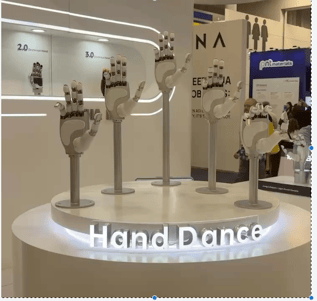
Several exhibits showcased robotic hands with increasingly human-like articulation and fine motor control. You could literally see the evolution from early mechanical designs to highly refined multi-degree-of-freedom systems capable of precise manipulation. Gripping, rotating, sensing, and adapting to objects are no longer unsolved problems — they're becoming productized.
This opens the door for robots to work directly with tools, parts, and complex assemblies — not just repetitive pick-and-place tasks behind safety cages.
Speed and Physical Confidence Change the Game
What really stopped me in my tracks were the humanoid robots operating directly on the show floor. These weren’t slow-moving research prototypes. They moved with speed, balance, and confidence. Demonstrators could push, shove, or physically disrupt the robot — and it would recover its balance and remain upright.
Watching a robot absorb physical interaction and stabilize itself is a powerful signal. Dynamic balance, control systems, sensing, and actuation have crossed a meaningful threshold.
You immediately start imagining real-world applications: industrial inspection, logistics, hazardous environments, field service, disaster response — and yes, even future military systems.
From Novelty to Inevitability
The takeaway wasn’t that robots are impressive — we’ve known that for years. The takeaway is that robots are becoming operationally credible. The convergence of sensors, perception, control systems, mechanical design, and learning models is producing machines that behave reliably in unpredictable environments.
Robots may be ready for deployment. Proving they’re ready at scale is now the real work.
Coming Next
Part 2 explores how wearable interfaces are becoming invisible.